
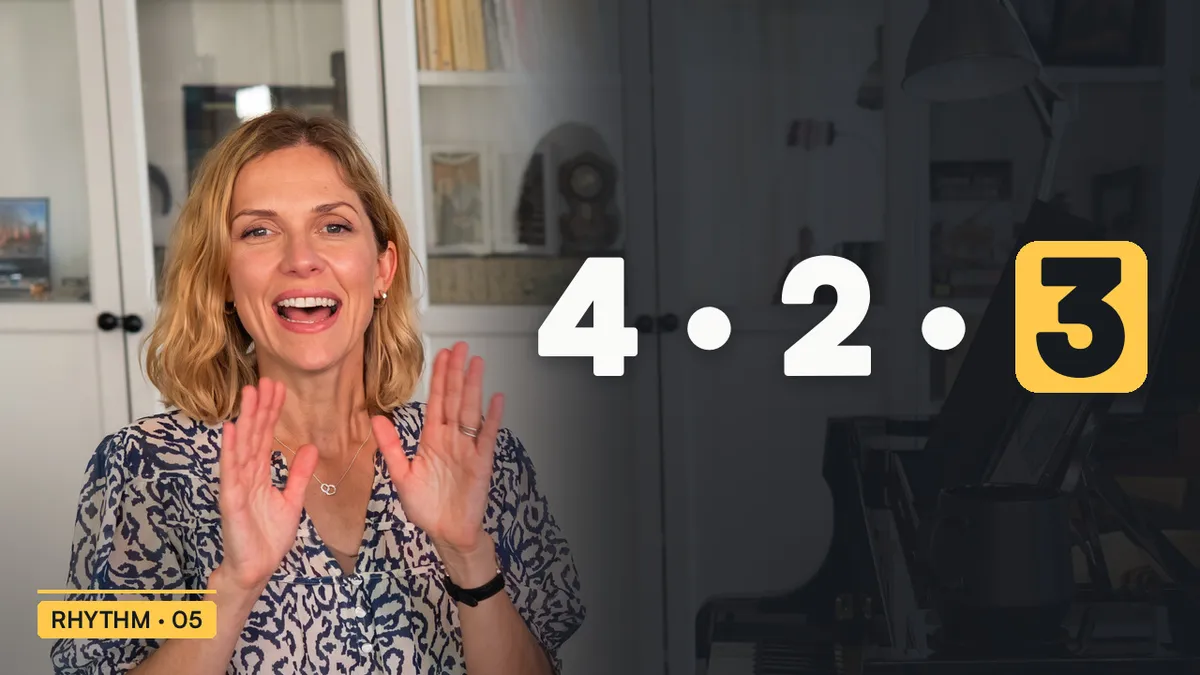
Whole, Half and Dotted Half Notes Explained: Why the Long Notes Are the Hard Ones
Lesson 5 of 21 in the free Rhythm for Adult Piano Beginners series. Prefer to watch in order? Open the full playlist on YouTube.
Same notes, completely different sound. The part most people get wrong is the part where nothing happens: they just have to hold and count. Whole half and dotted half notes are the long values, and the dot is where most adults get caught, so this lesson covers what each one is worth, why the dot adds half the note rather than a whole beat, and a clap-along so holding stops feeling like waiting.
These look like the easy notes. They are the ones adults rush most.
The problem: long notes feel like dead air
Fast notes keep you busy. Long notes ask you to do something harder: nothing, on purpose, for a measured amount of time. When an adult beginner reaches a whole note, their hands are still, their eyes jump ahead to the next bar, and the count in their head quietly speeds up. The note that was supposed to last four beats lasts three, and the piece sounds rushed without anyone being able to say why.
Then there is the dot. Almost every adult I teach has, at some point, believed that a dot adds one beat. It does not. It adds half the value of the note it sits beside, which is a rule that works for every dotted note you will ever meet, as long as you learn it as a rule and not as a single memorized answer.
So two things to fix: holding long notes with an active count, and understanding the dot as arithmetic rather than decoration.
How I teach it: the long notes, one at a time
The whole note and whole rest
A whole note has an open note head and no stem, and it lasts four beats. To clap it, you clap on beat one and hold through all four: one, two, three, four, with the count out loud the whole way. The whole rest looks like a small rectangle hanging down from a line, and it is four beats of silence. You stay silent, but you still count all four beats. The counting is what keeps the silence the right length.
The half note and half rest
A half note has an open note head with a stem, and it lasts two beats. In a bar of two half notes you clap on one, hold through two, clap on three, hold through four. The half rest sits on top of a line and looks a little like a hat; it is two beats of silence. If a bar has a half note and then a half rest, you clap on one, hold through two, and count three and four out loud with your hands apart.
The dotted half note
A dotted half note looks like a half note with a dot beside it. The dot adds half the value of the note. A half note is two beats; half of two is one; two plus one is three. So the dotted half note lasts three beats. In 4/4 you will often see it followed by a quarter note to complete the bar: clap on one, hold through two and three, clap on four. Learn the rule, not the answer, because the same dot will show up next to quarter notes and eighth notes later in this series and the arithmetic is identical.
The pyramid, and the pie
Put the long notes back into the rhythm pyramid and everything lines up. One whole note, four beats. Two half notes, two beats each, four beats. Four quarter notes, four beats. Eight eighth notes, half a beat each, four beats. Sixteen sixteenth notes, a quarter beat each, still four beats. If you would rather think about food than fractions, picture a pie: the whole note is the whole pie, the half note half the pie, the quarter note a quarter of it, and so on down. Either picture works. Pick the one that makes whole half and dotted half notes feel like parts of one thing instead of three separate facts.
Try this today: learn to hold without waiting
Count through the hold. Set a metronome to 60. Clap once and count one, two, three, four out loud, hands apart, then clap again on the next one. Do eight whole notes in a row. The goal is that the gap between claps is exactly four clicks every time, and you can only know that if you are counting out loud.
Half notes against the click. Same tempo. Clap on one and three only, counting all four numbers. Then add a half rest: clap on one, nothing on three, say three and four anyway. Notice how hard it is not to rush the empty half. That difficulty is the whole lesson.
Do the dot out loud. Clap on one, hold through two and three, clap on four. Say the arithmetic before you start: two plus one is three. Then run the call-and-response clap-along in the video, grab the Rhythm 102 worksheet, write the counting under the notes, and check the answer key on the back.
What 100 days of this looks like
Here is the arc I usually see when an adult does this every day. Your pace will be your own.
In the first two weeks, long notes still feel like waiting, and you will catch yourself speeding up through them. Catching yourself is the skill. By week three the count keeps going through the hold without effort, and the whole note starts to feel like a note you are playing rather than a gap you are surviving.
By the second month the dot is arithmetic, not a memory test, and you read dotted half notes in 3/4 and 4/4 without pausing. Around day 100, the slow pieces in your repertoire are the ones that sound most musical, because the long notes finally last their full length and the music has room to breathe. If you have made it this far in the series, you already know most of the note values there are. Most people never get this far. Keep going.
Questions adults ask about this lesson
How many beats does a dotted half note get?
Three beats. A half note is two beats, and the dot adds half of the note's value, which is one more beat. Two plus one equals three.
What does a dot do to a note in music?
A dot adds half the value of the note it follows. A dotted half note is two plus one, three beats; a dotted quarter note is one plus a half, one and a half beats; a dotted eighth note is three quarters of a beat.
What is the difference between a whole rest and a half rest?
The whole rest hangs down from a line and lasts four beats of silence. The half rest sits on top of a line, looks a bit like a hat, and lasts two beats of silence. You count both out loud without clapping.
Why do beginners rush long notes?
Because nothing is happening and attention jumps ahead. The fix is to count out loud through the hold, so the silence between claps is measured instead of guessed.
Work with Stacey
You can learn a lot of this on your own. What you cannot do on your own is hear what your playing sounds like to a teacher, or know which of the twenty small things you could fix is the one that matters this week.
That is what a consultation is for. We talk about where you are, what you want to be able to play, and whether working together one on one makes sense. It is a conversation, not a pitch, and it is free.
Book a free consultation with StaceyIf you would rather start with a plan than with theory, my free 7-Day Piano Kickstart walks you through three real songs, both hands together, over seven days.
Piano Skool is online piano education for adults (18+). Educational purposes only; results vary with practice and consistency. Nothing here is a promise about how fast you will progress.
Previous lesson: Quarter, Eighth and Sixteenth Notes Explained for Adult Piano Beginners. Start from the beginning: What Is Rhythm in Music? Piano Basics for Adult Beginners. Next lesson: Time Signatures Explained: 4/4, Ties and the Dotted Quarter Note. Follow the playlist so you do not miss it.


