
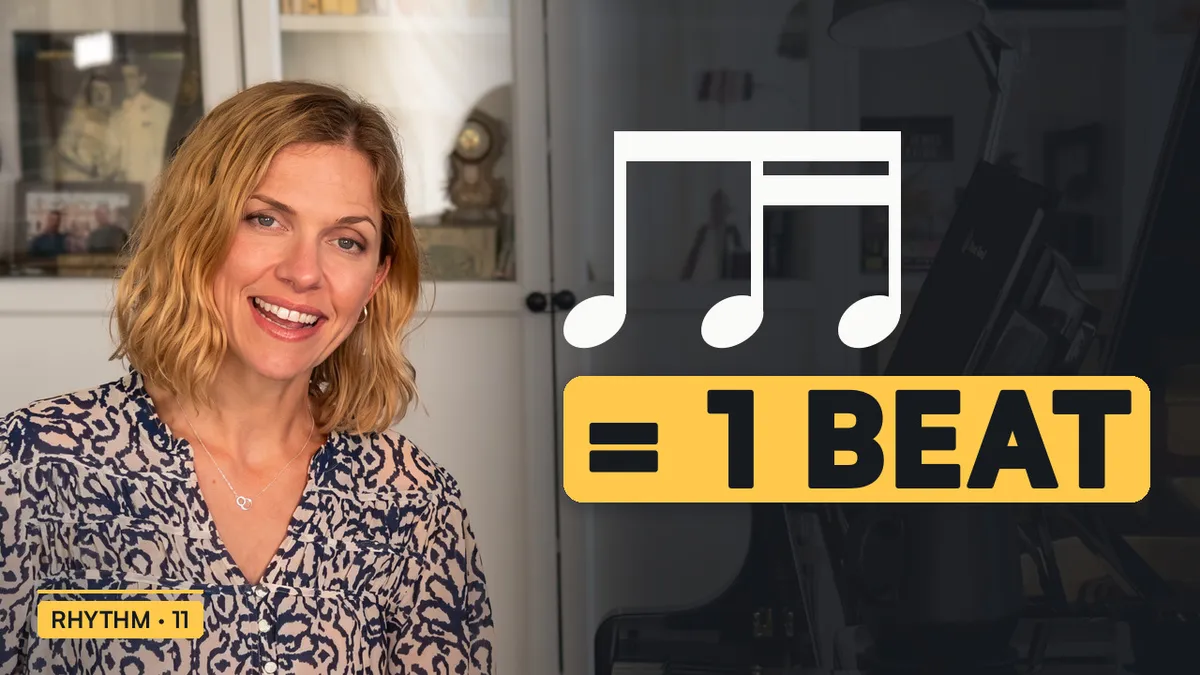
How to Count an Eighth and Two Sixteenths (Without Losing the Beat)
Lesson 11 of 21 in the free Rhythm for Adult Piano Beginners series. Prefer to watch in order? Open the full playlist on YouTube.
Here is one reason most beginners never get to the next level: there are a handful of rhythm patterns that show up constantly in intermediate music, and almost everyone gets confused by them. This is the first one. An eighth note beamed to two sixteenths is one beat, and knowing how to count an eighth and two sixteenths is what separates the adults who can read real repertoire from the ones who stall at the easy arrangements. This lesson covers what the beam is telling you, two different ways to count it out loud, and which one to reach for when the other keeps falling apart.
The clap-along in this one is long on purpose. This pattern needs the repetitions.
The problem: one beat that looks like three notes
By this point in the series you can count quarters, eighths and sixteenths separately. The trouble starts when they mix inside a single beat. You see three note heads under one beam and your eye reads three events of equal weight, so the eighth note gets rushed to the length of the sixteenths, or the sixteenths get stretched to match the eighth, and either way the beat comes out the wrong length.
The second problem is counting words. One e and a is the right subdivision, but if you say all four syllables and only two of them have notes, it is easy to lose track of which syllable you are supposed to clap on. So some adults drop the counting entirely and go by feel, which works until the pattern appears in a piece they do not already know.
The pattern is not hard. It is just unfamiliar, and unfamiliar things need a system.
How I teach it: the beam is the clue
Beamed together means one beat
When notes are beamed across like this, the beam is telling you that together they equal one beat. Here that is an eighth note, worth half a beat, followed by two sixteenth notes, each worth a quarter of a beat, which together make the other half. Half plus a quarter plus a quarter equals one. The first half of the beat belongs to the eighth note; the second half is split between the two sixteenths.
Counting it as one and a
The first way to count it is to say only the syllables that have notes: one and a, two and a, three and a, four and a. The eighth note falls on the number, and the two sixteenths fall on and and a. This version is compact and it matches the rhythm you hear, which many adults find easier at first.
Counting it as one e and a
The alternative is to say every subdivision in the measure, one e and a, two e and a, and clap on one, and and a, staying silent on the e. The eighth note simply covers two syllables. This version gives you a more consistent counting pattern across a whole piece, especially when the next beat has four sixteenths in it, because the syllables never change; only where you clap changes.
Pick the one that works for you
It depends on your preference. Try both and see which one stays steady. If one and a keeps collapsing when the tempo rises, switch to one e and a; the extra syllable is a handrail. If one e and a feels like too many words, use one and a. Either way, this is how to count an eighth and two sixteenths: anchor the eighth on the number, and split the second half of the beat between two short syllables. Coming lessons flip this pattern around, and songs often chain several variations together, so get this one solid on its own first.
Try this today: anchor the eighth, split the rest
Say it before you clap it. Set a metronome to 60. Say one and a, two and a, three and a, four and a out loud with the clicks on the numbers, no clapping, for four bars. Then say one e and a, two e and a, clicks on the numbers, four bars. You are learning the words before the movement.
Clap the pattern on one beat only. Count a full bar of one e and a, and clap the eighth-two-sixteenths pattern on beat one only, leaving beats two, three and four as plain quarter notes. Then move the pattern to beat two. Then three. Then four. Isolating it on one beat keeps the rest of the bar steady while you learn it.
Fill the bar. Now clap the pattern on every beat for four bars, using whichever counting word survived step one. Then run the long call-and-response clap-along in the video, write the counting into the Rhythm 204 worksheet, and check the answer key on the back.
What 100 days of this looks like
Here is the arc I usually see when an adult does this every day. Your pace will be your own.
In the first week, the eighth note keeps getting clipped and the sixteenths keep getting stretched. By the second week, the isolation drill has done its work and the pattern sits correctly on any beat you put it on. You also know which counting word is yours, which saves you a decision every time the pattern appears.
By the second month, you see three note heads under a beam and read one beat instead of three notes, which is a reading skill, not just a rhythm skill. Around day 100, this pattern and its two variations, which come in the next lessons, are shapes you recognize on sight. The intermediate pieces that used to stop you at this exact spot now stop you somewhere else, which is the honest definition of getting to the next level.
Questions adults ask about this lesson
How do you count an eighth note followed by two sixteenth notes?
Either one and a, clapping on each syllable, or one e and a, clapping on one, and and a while staying silent on the e. The eighth note takes the first half of the beat and the two sixteenths share the second half.
Why are the eighth and two sixteenths beamed together?
The beam tells you the group adds up to one beat: half a beat for the eighth note plus a quarter beat for each sixteenth. Reading the beam as one beat is the key to not rushing or stretching the notes.
Which counting method is better, one and a or 1 e and a?
Whichever stays steady for you. One and a matches the sound and is compact; 1 e and a keeps the same syllables through a whole piece, which helps when beats with four sixteenths follow.
Where does this rhythm show up in real music?
Everywhere in intermediate and advanced repertoire, often chained with its variations: two sixteenths and an eighth, and sixteenth-eighth-sixteenth. Learning each one separately makes the combinations readable.
Work with Stacey
You can learn a lot of this on your own. What you cannot do on your own is hear what your playing sounds like to a teacher, or know which of the twenty small things you could fix is the one that matters this week.
That is what a consultation is for. We talk about where you are, what you want to be able to play, and whether working together one on one makes sense. It is a conversation, not a pitch, and it is free.
Book a free consultation with StaceyNot sure whether rhythm, reading or technique is what is actually holding you back? My free 3-minute piano level quiz names your number one bottleneck and what to do about it.
Piano Skool is online piano education for adults (18+). Educational purposes only; results vary with practice and consistency. Nothing here is a promise about how fast you will progress.
Previous lesson: Cut Time Explained: 2/2 and 2/4 Time, Same Notes, Different Feel. Start from the beginning: What Is Rhythm in Music? Piano Basics for Adult Beginners. Next lesson: How to Count Two Sixteenths and an Eighth: The Mirror-Image Rhythm. Follow the playlist so you do not miss it.


