
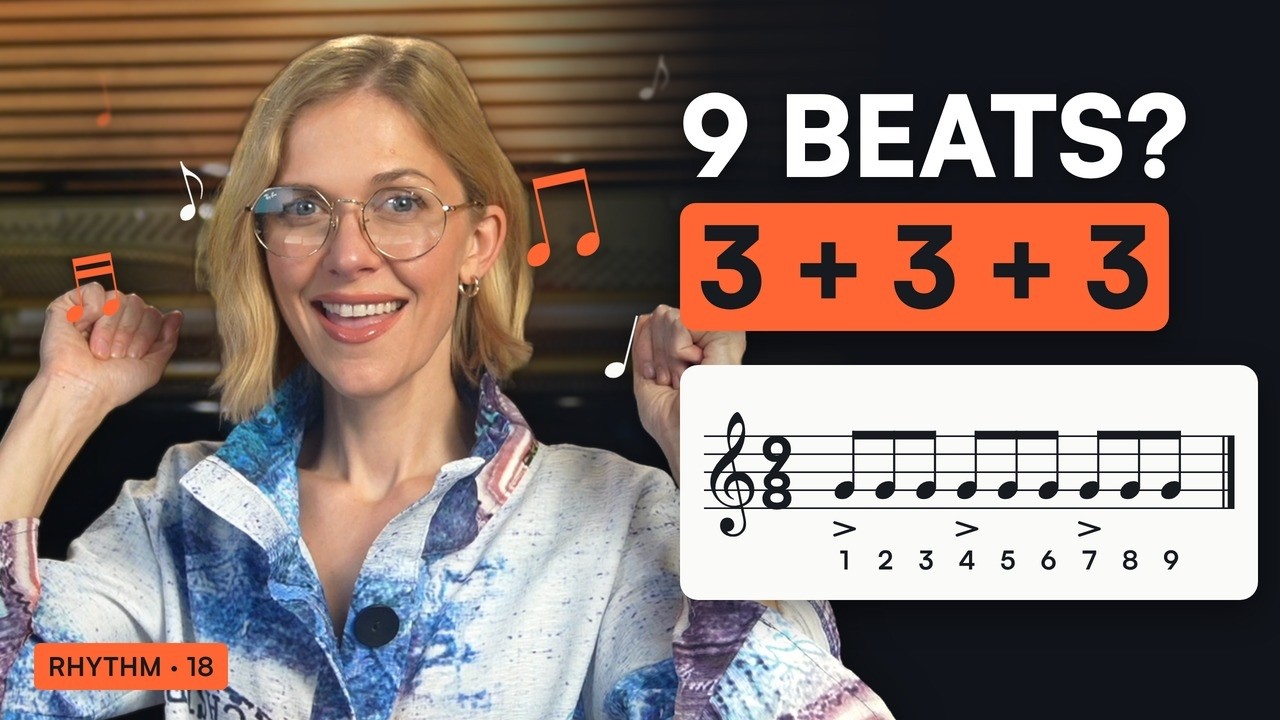
The 9/8 Time Signature Explained: Nine Beats That Roll
Lesson 18 of 21 in the free Rhythm for Adult Piano Beginners series. Prefer to watch in order? Open the full playlist on YouTube.
Nine beats in a bar. That is usually the point where people decide this one is not for them. It is not nine of anything you cannot keep track of, and you have almost certainly heard it in something you love. The 9/8 time signature is part of the same family as 3/4, 3/8 and 6/8, with a rolling quality of its own, and this lesson covers what the numbers mean, where the groupings fall, how to count it without losing your place, and the famous piano piece written in it.
If you did the 6/8 lesson, you already have most of this. Nine is six plus one more group of three.
The problem: nine sounds like too many
The number itself is the obstacle. Adults see a 9 on top and imagine counting to nine in their head while playing, which feels impossible, so they either avoid pieces in 9/8 or they count them in three and hope. Counting in three almost works, which is exactly what makes it a trap: the bar lines arrive in the wrong places and the phrasing never quite lands.
The other trap is the eighth note on the bottom. As with 6/8, the eighth note is the beat here, and adults who have just gotten comfortable with 6/8 sometimes expect 9/8 to feel like 6/8 with something tacked on, rather than three even beats of three. The feel is rolling and circular, often described as a kind of continuous turning, and if you count it as nine separate items, you lose that entirely.
The fix is to stop counting to nine and start counting to three, three times.
How I teach it: three groups of three
What 9/8 means
The 9/8 time signature means there are nine beats per measure, and the eighth note gets one beat. It belongs to the same rhythmic family as 3/4, 3/8 and 6/8, all of which organize around the number three, but it has its own character.
Felt in three groups of three
It is typically counted in three groups of three beats. Each measure has nine beats felt as ONE two three FOUR five six SEVEN eight nine, with the weight on one, four and seven. In practice you can think of it as three big beats, each dividing into three, the way 6/8 is two big beats of three. That is why nine never feels like nine when you play it: you are feeling three pulses that each roll.
The rolling quality, and where it shows up
9/8 has a unique rhythmic quality, often described as rolling or circular, and that motion is why it appears in so many genres, from classical to folk to Metallica. The most famous piano piece written in it is Debussy's Clair de Lune, and the reason that piece seems to float is exactly this meter: three groups of three, turning over and over, with the strong beats soft enough that you feel the motion more than the pulse.
So the 9/8 time signature is not an exotic one. It is 6/8 with one more group, counted ONE two three FOUR five six SEVEN eight nine, and the moment you feel it as three rolling beats, the number nine disappears.
Try this today: three threes
Count to three, three times. Set a metronome to 120 so each click is an eighth note. Count one two three four five six seven eight nine, clapping only on one, four and seven. Four bars. Feel the three big beats before you worry about the nine small ones.
Compare with 6/8. Clap one bar of 6/8, accents on one and four, then one bar of 9/8, accents on one, four and seven. Alternate. The only difference is the extra group, and feeling that side by side is what makes 9/8 stop being a new world.
All nine with a lean. Clap every eighth note, making one, four and seven louder. Then listen to the opening of Clair de Lune and count along quietly. Clap along with the video, then write the counting into the Rhythm 401 worksheet and check it on the back.
What 100 days of this looks like
Here is the arc I usually see when an adult does this every day. Your pace will be your own.
In the first week, you still try to count to nine and lose your place around seven. By the second week, the three-threes drill has reorganized the bar in your head, and 9/8 feels like a slightly longer 6/8. You hear the roll in recordings before you see the time signature.
By the second month, compound meters as a group make sense: 3/8, 6/8 and 9/8 are the same idea with one, two or three groups, and a 12/8 blues later on is simply four. Around day 100, a piece like Clair de Lune is a rhythm you understand rather than a mood you imitate, and that understanding is what lets you play it with the floating quality it is famous for. Nine beats was never the problem. Counting them as nine was.
Questions adults ask about this lesson
How do you count 9/8 time?
Count all nine eighth-note beats, but feel them in three groups of three with the weight on one, four and seven: ONE two three FOUR five six SEVEN eight nine.
What famous piano piece is in 9/8?
Debussy's Clair de Lune. Its floating, rolling quality comes directly from the three-groups-of-three feel of 9/8.
What is the difference between 6/8 and 9/8?
6/8 has six eighth-note beats felt as two groups of three. 9/8 has nine eighth-note beats felt as three groups of three. Same rolling feel, one more group per bar.
Is 9/8 only used in classical music?
No. The rolling, circular motion of 9/8 shows up across genres, from classical to folk to rock bands such as Metallica.
Work with Stacey
You can learn a lot of this on your own. What you cannot do on your own is hear what your playing sounds like to a teacher, or know which of the twenty small things you could fix is the one that matters this week.
That is what a consultation is for. We talk about where you are, what you want to be able to play, and whether working together one on one makes sense. It is a conversation, not a pitch, and it is free.
Book a free consultation with StaceyNot sure whether rhythm, reading or technique is what is actually holding you back? My free 3-minute piano level quiz names your number one bottleneck and what to do about it.
Piano Skool is online piano education for adults (18+). Educational purposes only; results vary with practice and consistency. Nothing here is a promise about how fast you will progress.
Previous lesson: Triplets With Rests: Easier Than They Look. Start from the beginning: What Is Rhythm in Music? Piano Basics for Adult Beginners. Next lesson: The 5/4 Time Signature Explained: How to Count Five Beats. Follow the playlist so you do not miss it.


